

My brain goes insane when I try to pray.
I typically wake up before everyone in my house. It’s quiet. There are no distractions. I have time to take a deep breath and “just be” with God. I make my coffee, sit down in my chair, and exhale.
“Here I am, Lord….”
And then it happens. Every item on my to-do list, every problem at work, every worry over my children suddenly rushes to the front of my mind all at once. So much for resting in the security of God’s love. So much for peace.
The house might be quiet, but my brain is LOUD.
I crave structure to a fault. It makes me feel like I’m in control, which is hilarious because so much of life is unstructured and so many things are obviously out of my control. In my worst moments, I’m aggravated or upset or anxious because my plans have been thwarted by someone or something else.
When I have no direction and no plan, I tend to flail aimlessly. I’m the super fun guy who, when given a product that requires assembly, reads the instruction manual all the way through before doing anything else. Spontaneity is not my forte. God bless my wife.
But these are topics for another day. Let me go back to prayer.
When I enter into prayer without a general plan, my mind often takes me places far away from where I want to go, and I leave feeling no more connected to God than before I started.
Enter methods of prayer. There are a lot of them out there. I’ve tried many, and they’re all good. Of course, the ultimate method is using the Lord’s prayer as a guide. You can’t go wrong with praying the Psalms. The Examen is a helpful practice to end your days. But I recently stumbled across one that has clicked with the way God has wired me.
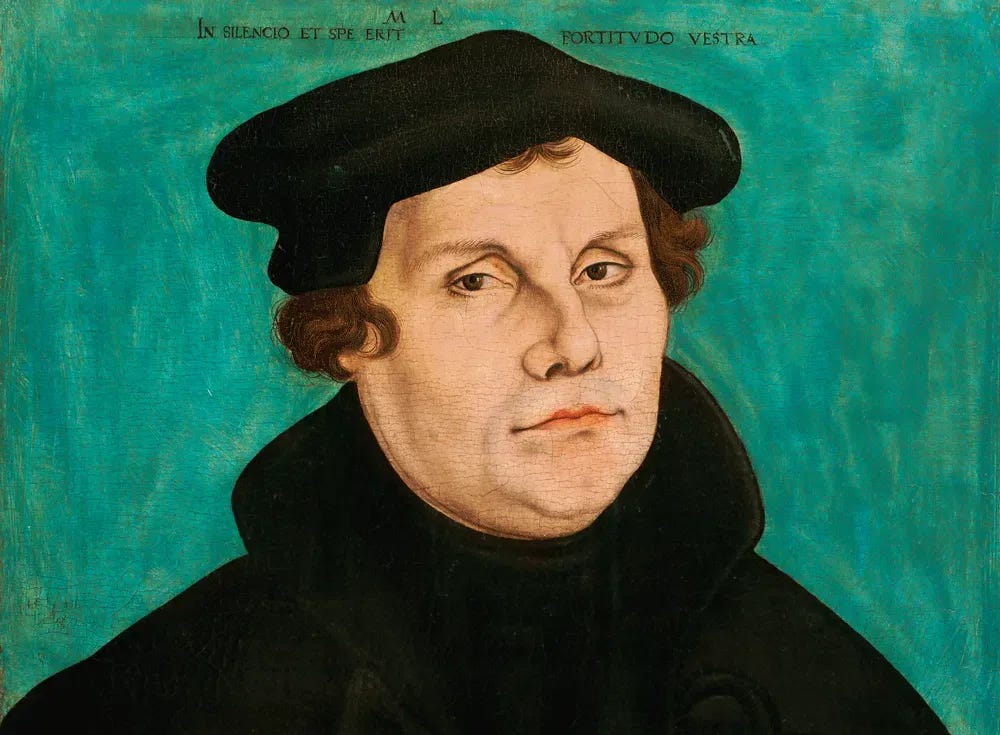
Back in 1535, Martin Luther had a friend who asked him for suggestions about how to pray. Luther, being Luther, responded with an open letter titled How One Should Pray, for Master Peter the Barber. In the letter, Luther talks about how he prays the Ten Commandments by dividing each commandment into four strands:
Instruction - What does the text teach?
Thanksgiving - What does the text cause me to be thankful for?
Confession - What does the text convict me to confess?
Prayer - What does the text prompt me to ask God for?
While Luther focused on the Ten Commandments, I’ve found this framework helpful for praying over any Scripture.
For example, this is a verse that stood out to me recently and how I used Luther’s method to guide me in prayer.
Then Elisha prayed and said, ‘O Lord, please open his eyes that he may see.’ So the Lord opened the eyes of the young man, and he saw, and behold, the mountain was full of horses and chariots of fire all around Elisha.
2 Kings 6:17
Instruction: There are spiritual forces at work that we can’t see. God is always with us. We’re never alone.
Thanksgiving: God, I’m so grateful that you watch over me and my family. Thank you for being a God who loves us, who works things to the good for those who believe, who is for us, who provides us with protection from the temptations of the world.
Confession: Lord, I’m sorry that I so often forget how present you are. I focus my eyes on the world instead of you. I try to fight my battles alone. I forget that you love me enough to die for me. I forget that, because of Jesus, I’m an heir to your kingdom. Thank you for your perfect forgiveness and for saving me from myself.
Prayer: Father, open our eyes like the young man in the passage. Help us to see the horses and chariots of fire all around us. Let us become more aware of your presence. Let us experience the glory of your goodness. Amen.
That’s it. Pretty simple, really, but I thought it might be helpful to someone who struggles to stay focused in prayer like I do.
The most important part in your prayer life is to keep showing up. God comes to those who want him.